Solandra grandiflora

GOLDKELCHWEIN

Englische Bezeichnung: Solandra Grandiflora, Showy Chalicevine, Papaturra
Spanische Bezeichnung: Copa de Oro

Familie  

Nachtschattengewächse (Solanaceae)

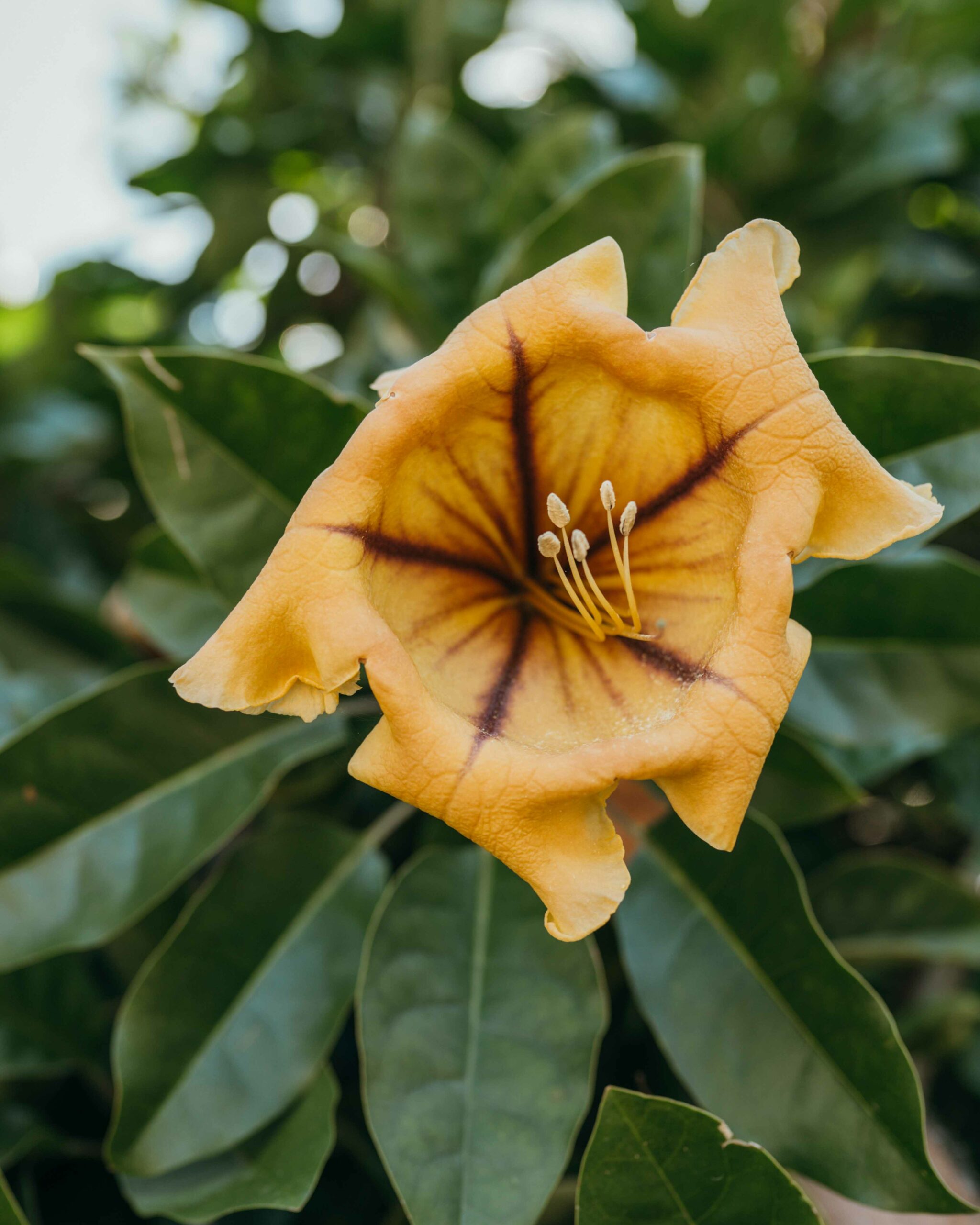
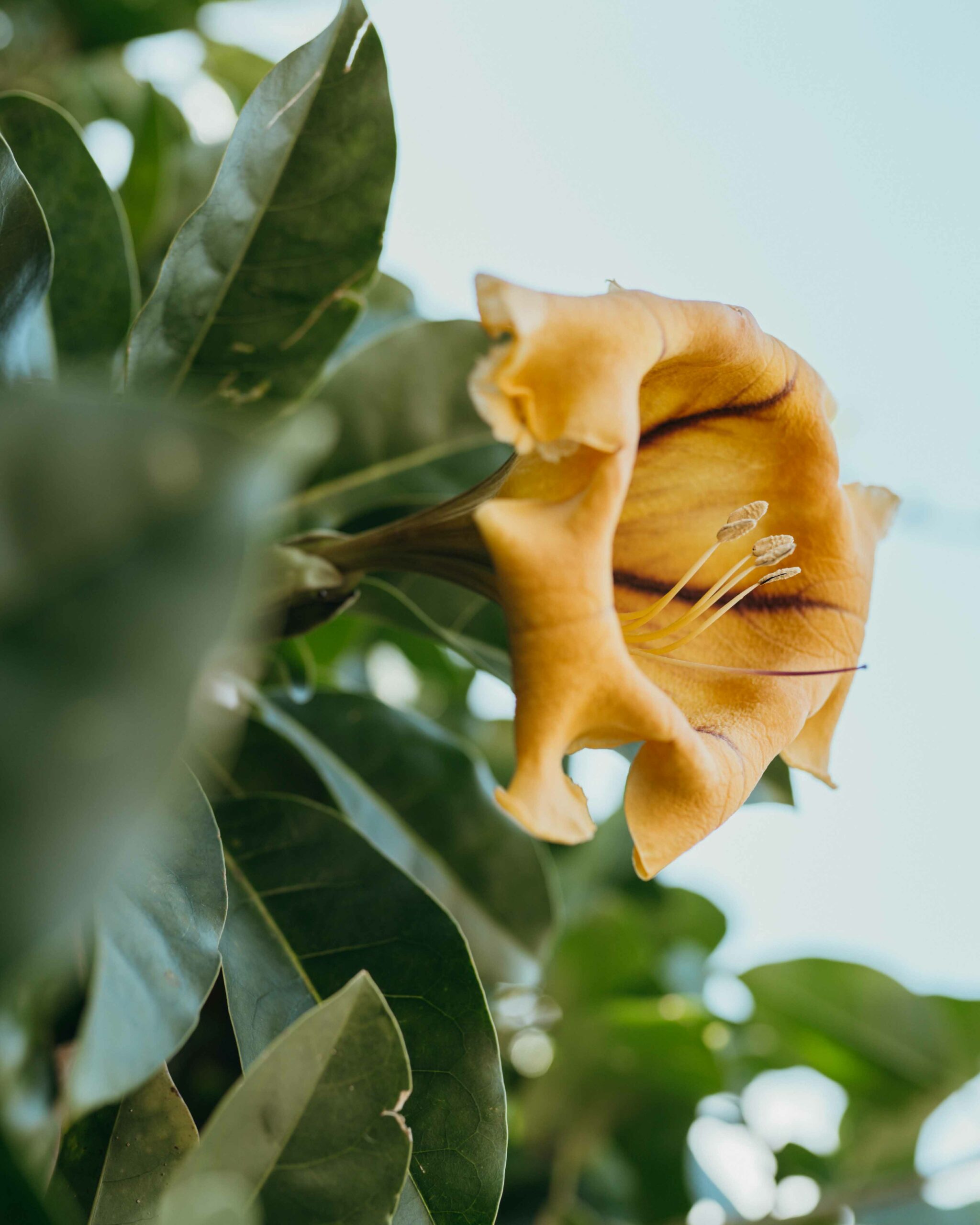
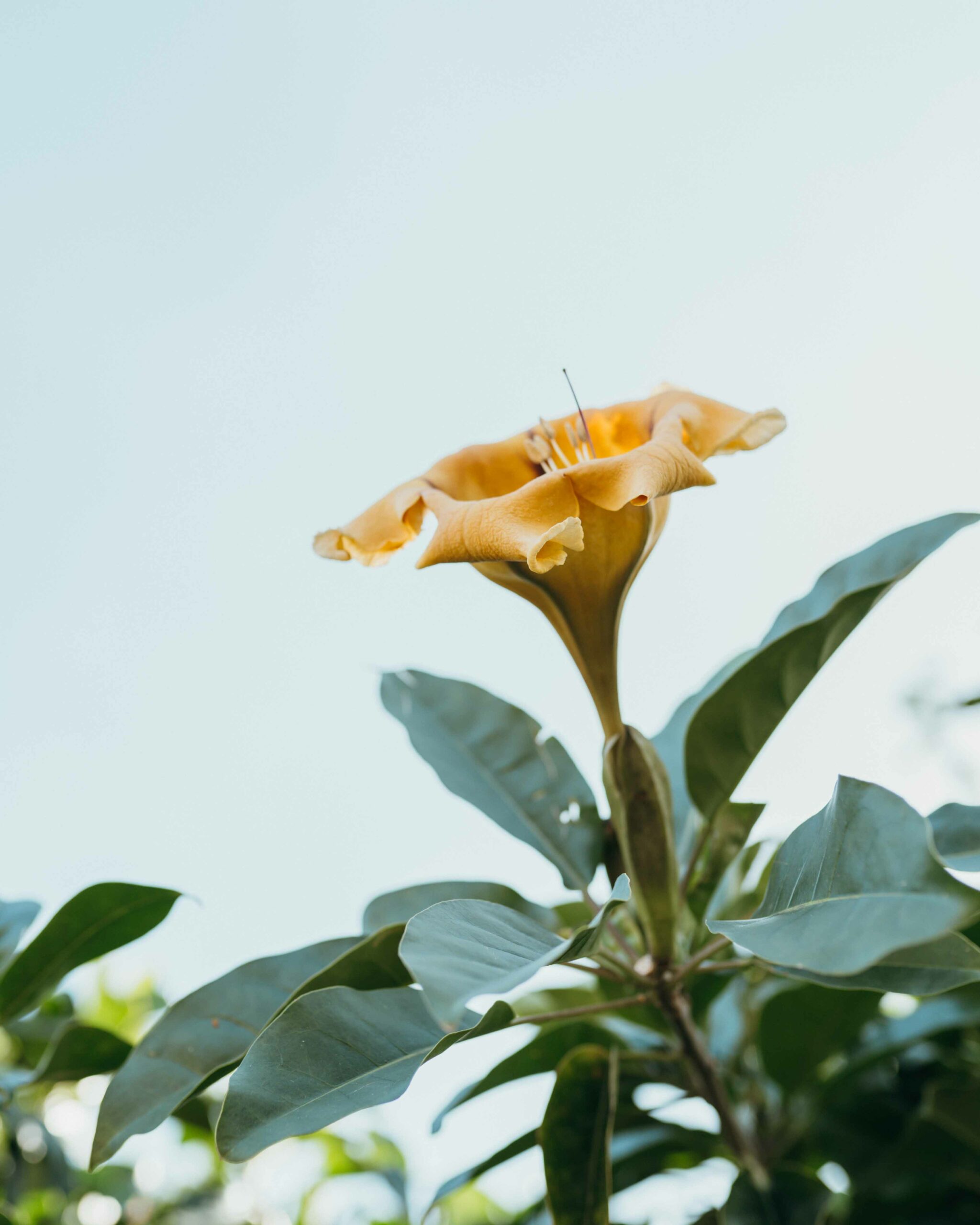
Der Goldkelchwein gehört zu den beeindruckendsten exotischen Kletterpflanzen. Zunächst wächst eine keulenförmige Knospe, die früh die beeindruckenden Dimensionen der Blüten zeigen. Diese erreichen einen Durchmesser von 15 bis 20 cm und haben harmonisch gefaltete Blütenblätter. Violette Streifen, die an den Rändern ausfransen, geben den gelben Kelchen ein markantes und elegantes Erscheinungsbild. Die Farbe wechselt von einem helleren Gelb bei der jungen Blüte zu einem dunklen Gelb im späteren Verlauf. Wenn die Blüte der Solandra verblüht wird sie dann noch hellorange.
Aufgrund des Alkaloidgehaltes wurden die Pflanzen bereits in Vor-kolumbianischer Zeit als Entheogen und magische Pflanze eingesetzt. Indigene Bewohnern Mexikos verwenden Pflanzenteile als Halluzinogen.

Ethnografische Berichte über die Verwendung des Goldkelchs sind rar, weil Solandra nur selten als schamanische Trancedroge verwendet werden. Am besten ist die Verwendung der „Götterpflanze“ kiéli oder kiéri bei den Huicholindianer bekannt. Diese Ureinwohner im heutigen mexikanischen Bundesstaat Jalisco verwenden zumindest eine Art (Solandra brevicalyx) nachweislich.

Bei den Huichol dreht sich ein ganzer Mythenzyklus um die Pflanze. So sei Solandra ursprünglich ein Gott namens „Kiéli Tewiali“, zu deutsch Gott des Windes und der Zauberei. Nach diesem Glauben ging er zu Anbeginn der Zeit aus der Vereinigung der kosmischen Schlange mit dem Regen hervor. Später verwandelte er sich – zum Nutzen und Segen der Menschheit – in die Pflanze mit dem betörenden Duft, dem „Baum des Windes“. Da die „Götterpflanze“ als sehr kraftvoll gilt, wird sie gerade auch für dunkle Zwecke (Schadzauber, Todeszauber) verwendet. So darf die Pflanze auch nicht gestört oder beleidigt werden; sonst drohen als Strafe Wahnsinn oder gar Tod. Der Pflanze werden auch Opfer dargebracht: unter anderem Zeremonialpfeifen, Maisfladen, Tequila, Münzen, Wollgarnbilder und Schmuck. Die Pflanze wird nur sehr selten als Halluzinogen eingenommen. Bevorzugt werden dazu die Blätter, als potenter gelten aber Früchte und Wurzel.

In der Volksmedizin Mexikos werden Solandra vor allem als Liebestrank und Aphrodisiakum angewendet. Ein Tee aus der Blüte wird auch gegen Husten getrunken.


Family

Nightshade family (Solanaceae)

The golden chalice vine is one of the most impressive exotic climbing plants. It starts with a club-shaped bud, which early on reveals the impressive dimensions of the flowers. These reach a diameter of 15 to 20 cm and have harmoniously folded petals. Violet stripes, which fray at the edges, give the yellow calyxes a striking and elegant appearance. The colour changes from a lighter yellow in the young flower to a dark yellow later on. When the Solandra flower fades, it turns light orange.
Due to their alkaloid content, the plants were already used as entheogens and magical plants in pre-Columbian times. Indigenous inhabitants of Mexico use parts of the plant as a hallucinogen.
Ethnographic reports on the use of the golden chalice are rare because Solandra is rarely used as a shamanic trance drug. The best-known use of the ‘plant of the gods’ kiéli or kiéri is among the Huichol Indians. These indigenous people in what is now the Mexican state of Jalisco have been proven to use at least one species (Solandra brevicalyx).
The golden chalice vine is one of the most impressive exotic climbing plants. It starts out as a club-shaped bud, which early on develops the impressive
The Huichol people have a whole cycle of myths surrounding the plant. Solandra was originally a god named ‘Kiéli Tewiali’, meaning god of wind and magic. According to this belief, he emerged at the beginning of time from the union of the cosmic serpent with the rain. Later, he transformed himself – for the benefit and blessing of mankind – into the plant with the beguiling scent, the ‘tree of the wind’. As the ‘plant of the gods’ is considered very powerful, it is also used for dark purposes (spells of harm, death spells). The plant must not be disturbed or offended, otherwise madness or even death may be the punishment. Sacrifices are also made to the plant, including ceremonial pipes, corn cakes, tequila, coins, wool yarn pictures and jewellery. The plant is very rarely taken as a hallucinogen. The leaves are preferred for this purpose, but the fruits and roots are considered more potent.
In Mexican folk medicine, solandra is mainly used as a love potion and aphrodisiac. A tea made from the flowers is also drunk to relieve coughs.

Familia 

Solanáceas (Solanaceae)

La calicínia es una de las plantas trepadoras exóticas más impresionantes. Al principio crece un capullo en forma de maza que pronto muestra las impresionantes dimensiones de las flores. Estas alcanzan un diámetro de entre 15 y 20 cm y tienen pétalos armoniosamente plegados. Las rayas violetas, que se deshilachan en los bordes, dan a los cálices amarillos un aspecto llamativo y elegante. El color cambia de un amarillo más claro en la flor joven a un amarillo oscuro en la etapa posterior. Cuando la flor de la Solandra se marchita, se vuelve de color naranja claro.
Debido a su contenido en alcaloides, estas plantas ya se utilizaban en la época precolombina como enteógenos y plantas mágicas. Los indígenas de México utilizan partes de la planta como alucinógenos.
Los informes etnográficos sobre el uso de la copa de oro son escasos, ya que la Solandra rara vez se utiliza como droga chamánica para alcanzar el trance. El uso más conocido de la «planta de los dioses» kiéli o kiéri es el de los indios huicholes. Se ha demostrado que estos indígenas del actual estado mexicano de Jalisco utilizan al menos una especie (Solandra brevicalyx).
Entre los huicholes existe todo un ciclo mitológico en torno a esta planta. Según ellos, Solandra era originalmente un dios llamado «Kiéli Tewiali», es decir, dios del viento y la magia. Según esta creencia, surgió al principio de los tiempos de la unión de la serpiente cósmica con la lluvia. Más tarde, se transformó, para beneficio y bendición de la humanidad, en la planta con el aroma embriagador, el «árbol del viento». Dado que la «planta de los dioses» se considera muy poderosa, se utiliza especialmente para fines oscuros (hechizos malignos, hechizos mortales). Por lo tanto, no se debe molestar ni ofender a la planta; de lo contrario, se corre el riesgo de sufrir locura o incluso la muerte como castigo. También se le ofrecen sacrificios a la planta: entre otros, pipas ceremoniales, tortas de maíz, tequila, monedas, imágenes de hilo de lana y joyas. La planta rara vez se consume como alucinógeno. Para ello se prefieren las hojas, pero se considera que los frutos y las raíces son más potentes.
En la medicina popular mexicana, la solandra se utiliza principalmente como filtro de amor y afrodisíaco. También se bebe una infusión de la flor para combatir la tos.